Free training · Flow Outcomes
Making quality records
Fourteen principles drawn from professional standards, statutory inquiries and records law: what they ask of you, and what they look like in practice. Have a go at the exercises as you reach them rather than reading past them; some are harder than they look, and getting one wrong is the point.
Four questions before you start
Nothing here is marked. It is worth noticing where you are starting from.
These four answers are counted anonymously, so we can see what the sector finds hardest. No name, no email, nothing that identifies you or your organisation, and nothing that could be traced back to either. Every other answer in this course stays on this device.
How equipped do you feel to include the child’s voice in your records?
How easy is it, right now, to make sure a note has everything it should?
Roughly what portion of your working week goes to documentation?
Which word is closest to how case note writing feels for you at the moment?
Before the fourteen principles
Why records matter
This short course is about making quality records. There are fourteen principles behind it, drawn from professional standards, from inquiries into how services have failed children, and from records law.
A few things worth knowing before you start.
Nothing is marked except the practice quiz at the end, and you can retake that as many times as you need.
There are tasks throughout. Have a go at them before you read on. Some are harder than they look, and getting one wrong is the point.
We are not assuming anything about the records you make now. Most of what follows is about pressure rather than skill, and what happens to a record when there are four more visits to write up and it is already five o’clock.
It applies whatever you make records in. Typed or spoken, in whatever system your organisation uses.
Why do records matter? Pick the reasons that ring true for you.
All of them. Every reason on that list is real, and this course covers all of them.
Most of what we know about why records matter comes from what happened when they were poor. Inquiries, court cases, people asking for their own file years later and finding almost nothing in it.
One entry from a file
This was made by a worker at the end of a long day. It is not unusual.
Home visit conducted. Mother presented as dysregulated and engagement was suboptimal. Home environment unkempt. Child displayed attachment-seeking behaviours throughout. Concerns remain regarding mother’s capacity. Will continue to monitor.
Kaylah is twenty-six. She has requested her file. This is one of the entries about the year she was removed.
She is looking for her childhood in it.
- A single word she said. She was there for the whole visit.
- Anything she did, except as a behaviour category.
- What the worker was actually worried about. “Capacity” could mean anything.
- What happened. Not one concrete thing.
- Her mother as a person. Only her failings.
Kaylah
I was seven. That’s the year they took us.
There are forty-one entries about that year. I’ve counted them.
One of them says my mother “presented as dysregulated” and that “engagement was suboptimal.” I’ve looked up what that means. I still don’t know what it means about my mum, on that day, in that house.
There’s one line about me. It says I “displayed attachment-seeking behaviours throughout.” I was there for the whole visit. I remember someone being there. And what got written down is that I displayed behaviours.
I wasn’t looking for anything dramatic. I wanted to know what our house looked like. Whether Mum was funny. What I was like as a kid, whether I talked a lot, what I played with.
There’s none of that. Forty-one entries, and I don’t know what I was like.
There’s one, though. Different worker, I think. It says I’d lined up all my toy cars along the edge of the rug, and I got upset when she moved one.
That’s it. That’s the one thing, out of a whole year.
Somebody spent thirty seconds writing that down, and it’s the only proof I’ve got that I was a kid.
Kaylah is a fictional character, a composite drawn from what care leavers describe finding in their files.This is just as important whether we are talking about concerns, or strengths and capacity.
When a worker has written down what a room looked like, what was agreed, and what a child said, a family can later show that things have changed. Vague notes can’t do that. Specific ones can.
Four principles that tend to fail together
Truthfulness
One
As soon as possible, while it’s fresh
Memory fades faster than people think, and the details that go first are the specific ones: what someone actually said, what you actually saw. Those are the parts worth having.
There’s a second reason. A record made at the time carries more weight than one made weeks later.
Two
Specific, not vague
Being accurate isn’t enough on its own. “The visit was good” might be completely true and still tell the next person nothing, not what was good about it, or what you meant by good.
Three
Fact separated from opinion, with how you came to that opinion explained
A reader needs to be able to tell three things apart: what the person said, what you saw, and what you think it means.
Your professional judgement belongs in the record. A note with no judgement in it isn’t a better note. If you think something, say it. But say what led you there, so the reader can see how you got from what happened to what you think.
“Mum is doing really well” needs its evidence just as much as a worry does. A strength recorded without what it rests on can’t be built on by the next worker, and can’t be shown to anyone reviewing the file later. What did you see or hear that made you think Mum is doing well?
Four
Nothing invented, nothing left out that should be there
These are two different failures. Making something up is rare. Leaving something out is not. It usually happens because the thing was uncomfortable, or because you were in a hurry and it seemed minor at the time.
A question people argue about
Should case notes be made in first person or third person?
Neither. Or rather, either.
This is one of the things practitioners argue about, and organisations sometimes mandate one or the other. Nothing in the research or the inquiries gives the pronoun any weight.
What they do point to is whether a reader can tell three things apart: what the person said, what you saw, and what you concluded.
“I saw two rubbish bags in the lounge room” works. So does “The worker observed two rubbish bags in the lounge room.” So does “It was noted that there were two rubbish bags in the lounge room.” All three tell you the same thing.
“The home was in a poor state” fails in every voice you could put it in. The problem was never the pronoun.
Use whichever your organisation asks for. Be consistent. Then spend the attention you were giving to the pronoun on the thing that actually matters.
Sort these ten
Each one is either something you saw, something the person said, or something you concluded.
Now say what you see
You have just walked into this lounge room. How would you put it in the record?
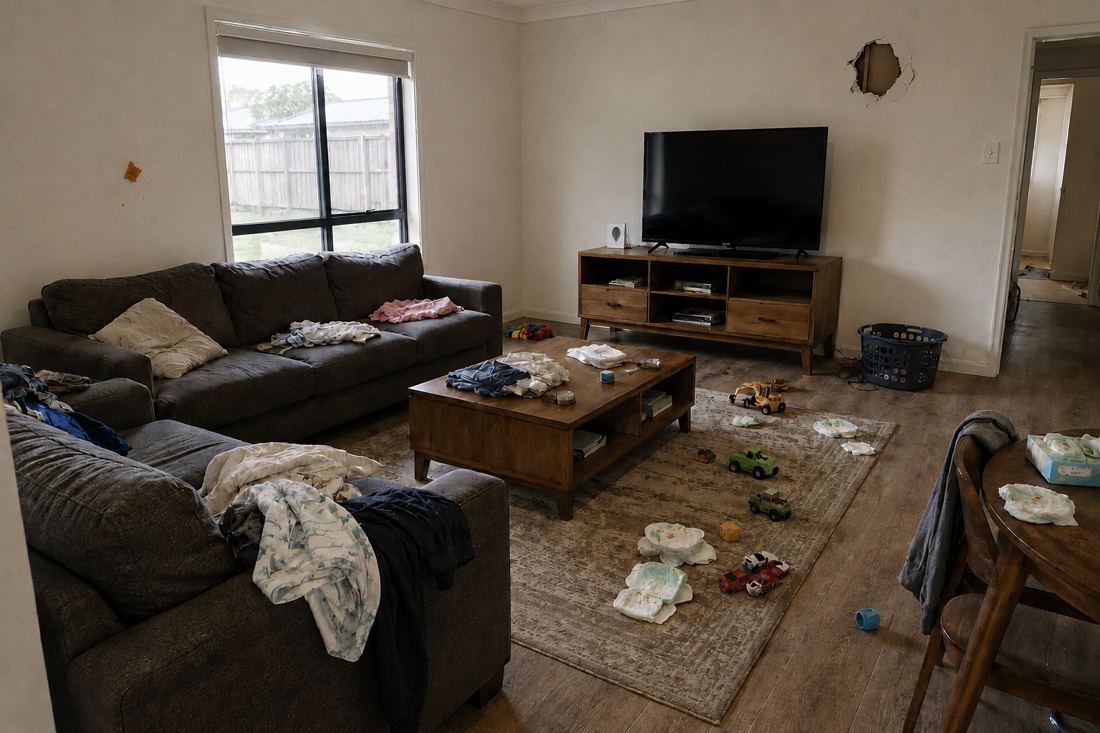
“The place is a dump.”
This tells the reader how the room felt, not what was in it. There is nothing underneath it for anyone to check.
“Dirty house.”
Quieter, and it reads as neutral. It is still a conclusion. Worth asking what “dirty” is standing in for. The floor is clear, the blind is up, the dishes aren’t stacked. What’s there is washing not put away and toys out.
“Washing and nappies everywhere, toys all over the floor.”
This is describing the room rather than judging it, and plenty of notes land here. “Everywhere” and “all over” are the limit. They can’t be checked, and they can’t be compared to next month.
“Washing on both couches and the coffee table, some folded. Nappies on the rug and floor, around six. Toy cars lined up on the rug. Hole in the plasterboard above the TV, about 100mm across.”
Every line could be checked by someone else. And there is something here to measure change against.
Some houses would take all day to describe. We don’t need to record every small detail. We need to record what matters.
The nappies say something about how the day is going. The hole is something someone will ask about. The toy cars show a child has been playing. Another practitioner might notice something different and be right to.
There is no rule that settles what matters. It is a judgement, and it is the hardest part of this. What helps is asking whether leaving something out would change what anyone does next.
Which is why this matters
Same room, six weeks later.
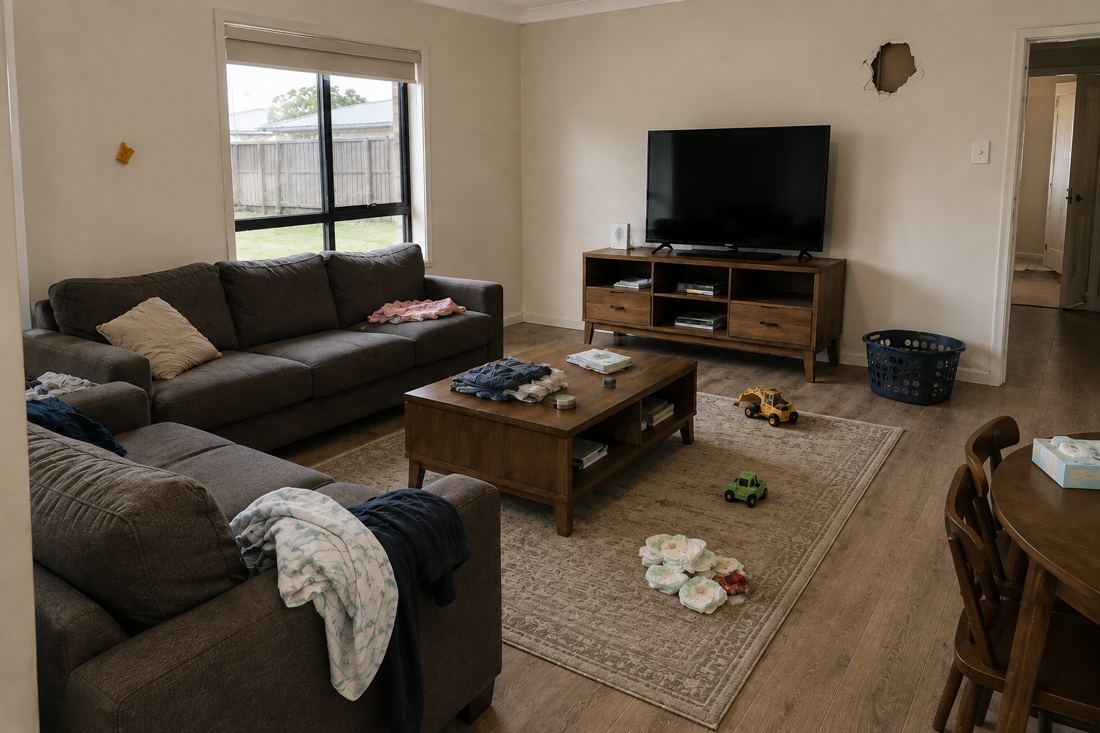
If you wrote “dirty house” in March, you can’t answer this. You’ve got nothing to compare against, so all you can say in May is that it looks a bit better, which is your impression, not evidence.
If you wrote what was actually there, you can say: washing folded and off the couch, nappies down from around six to four and gathered in one place, toys down to three. Nothing about the hole in the wall has changed.
That last sentence matters as much as the others. Specific description lets you see what hasn’t moved, not just what has.
What to include, and how to say it
Usefulness
Five
What’s relevant, not every single thing
Length feels like diligence. It reads as thoroughness and it feels safer. But a record that holds everything holds nothing in particular. The worry is in there somewhere, along with the weather and what was on the kitchen bench.
Long records fail predictably
- The important thing gets buried
- Padding reads as uncertainty. If it mattered, why is it in a list with everything else
- Nobody reads them properly, so the safety information doesn’t do its job
- Under scrutiny, volume doesn’t help. Buried reasoning reads worse than short, clear reasoning
Short records fail too. A missing child’s voice or a missing worry is the worse failure. Detail isn’t the enemy. Undirected detail is.
Writing a huge note that covers every angle, to protect ourselves, can have the effect of important details getting lost in the mass. And it doesn’t even do the job. If everything is in there with the same weight, nothing shows that you noticed the thing that mattered.
There’s a second problem. Everything you write about a family is something recorded about them without their say in it. Detail that serves no purpose isn’t neutral. It’s an intrusion into their life that didn’t need to happen.
A quality record includes the story and the relevant details, not every possible thing you can think of.
Six
Plain English, readable by the person
Jargon isn’t more professional. It’s less accurate. It swaps what happened for a category, and the reader has to guess what was underneath it.
JargonMother presented as dysregulated
BetterSarah was upset and finding it hard to calm down
What happenedSarah was crying when I arrived and raised her voice several times. Still upset when I left an hour later
JargonEngagement was suboptimal
BetterJamal didn’t want to talk to me today
What happenedJamal answered in one or two words and went to his room after about ten minutes
JargonThe home environment was unkempt
BetterThe house was messy
What happenedWashing on both couches and the coffee table, nappies on the rug, toy cars on the floor
JargonChild displayed attachment-seeking behaviours
BetterMia was clingy with her mum
What happenedMia stayed next to Sarah for the whole visit and held her hand
JargonPresented as appropriately attuned to the child’s needs
BetterSarah was good with Mia
What happenedSarah noticed when Mia got upset, stopped what she was doing and sat with her until she settled
The middle line is the important one. Anyone can spot the jargon. The trap is stopping at the plain version and thinking the job’s done. “Clingy”, “messy” and “good with Mia” are all judgements in everyday clothes.
A fair test: could a nine-year-old follow it? Not a simplified version for them and a real version for the file. One record.
Seven
Decisions, and why you made them
This isn’t the same as recording your judgement. You can write a well-reasoned worry and still not say what you did about it. Both belong: what you decided, and what led you there.
This is about the decisions that shape what happens next. A referral, a change in how often you visit, a decision not to act on something. Not every small choice you made during the visit.
Eight
Structured and findable
Most of this is handled by the system your organisation uses. Our role as practitioners is to use that system well and follow the procedures it sets.
In practice that looks like putting the record where it belongs rather than somewhere easier, using whatever headings or fields the system gives you rather than typing everything into one box, and recording it against the right person and the right date.
It sounds like housekeeping. The reason it matters is that a record nobody can find is a record that may as well not exist. If a worry about a child sits in a file note attached to the wrong sibling, or in a general contact log rather than where a reader would look, it won’t be there when someone needs it.
Cut it down
Click any part of this note to cut it. Cut what shouldn’t be there.
Most people cut these, and they’re right
The morning at the office, lunch, the traffic, the rain, the phone call on the way, the parking, the arrival time, the cup of tea, “Mia is in Year 3.” This is the worker’s day, not the family’s. None of it changes what anyone does next.
Also worth cutting: “I have seen this kind of situation before” and “it usually comes down to isolation.” That’s a pattern from other families being applied to this one. It reads as insight and it’s actually an assumption, and it will follow this family through the file.
Most people keep these, and they’re right
Mia’s four words. Sarah’s own account. The nappies, the washing, the toy cars. The hole and what Sarah said about it. Both agreements, with who made them. The worry, and what it rests on.
Also keep the TV off and the blind up. They look like filler and they aren’t. A TV off in the afternoon with a child home says something. So does an open blind. Small observations about the room are the kind of thing that turns out to matter later.
Same with “the house was in a similar state to previous visits.” That’s continuity, and only someone who has been there before can record it.
This is where it gets hard
The two unfamiliar cars in the driveway. Might be nothing. Might be the most important thing in the note. You can’t know, and neither can we. If a detail struck you as worth noticing, that instinct is usually worth trusting.
“I decided to use a strengths-based approach” and the reasoning behind it. Some organisations expect this. It’s about your practice rather than the family, and it can crowd out what actually happened. Worth knowing why you’re including it.
“Looked like she had been asleep.” You didn’t see her asleep. It’s a conclusion, and it happens to support the worry you’re about to record, which is exactly when a conclusion is most worth checking.
“Which is the second one she has missed.” Some people keep the missed appointment and cut the fact it’s the second. That’s the wrong half to lose. One missed appointment is an event. Two is the beginning of something, and the next worker can’t see it if you don’t write it.
“The visit felt more productive”, “I left feeling more hopeful”, “I found this visit quite difficult.” All about you rather than the family. But the last one is a supervision matter, and a supervisor might need to see it. No settled answer. What matters is noticing you’re recording your own feeling, and deciding on purpose.
Another practitioner would cut this differently, and could defend it. The skill isn’t getting to the same answer as someone else. It’s being able to say why each thing stayed.
How the record treats the person it’s about
Respect
Nine
In the person’s own words
Files about children have tended to be written by adults, for other adults. The child’s own voice was rarely in them, and neither was the parent’s. When people read their file years later, that absence is what they notice. Pages about them, with nothing of them in it.
Quoting takes seconds. “Mum’s been sad” is four words. So is “I like it when Mum reads to me.” Either one might be the most valuable thing in the note.
Ten
No labels
Researchers gave 413 medical students and trainee doctors one of two notes about the same imaginary patient. The medical facts were identical. The only difference was that one note carried extra wording that wasn’t needed, and that implied a judgement about him.
Note without the extra wording
Same patient. Same medical facts. Neutral description.
Readers held more positive attitudes towards him.
Note with extra wording added
Same patient. Same medical facts. Wording implying a judgement.
Readers held more negative attitudes, and gave him less pain relief.
Beach, M.C. et al. (2018). Testimonial injustice: Linguistic bias in the medical records of Black patients and women. Journal of General Internal Medicine.
He did not exist. Nothing about him differed except how the previous clinician had written about him.
That is how bias travels. Not through the person, through the record.
Eleven
Made knowing the person will read it
They have a right to the file and the means to get it. Records get accessed under freedom of information, subpoenaed, produced in court and read by inquiries.
One way to hold this in mind is to make the record as if the person is sitting next to you. We would talk respectfully about them. We wouldn’t hide a worry in soft language, because they would know what you meant anyway and would rather you said it plainly. We would get their words right, because they are there to correct us.
Saying it simply is not saying it gently. A child reading their file deserves to know what you were worried about. Take the jargon out, leave the concern in.
Same visit, two records
Which would you want made about you?
Version B, almost always.
What B has that A doesn’t:
- Sarah’s own words and Mia’s. Four words from a child that version A erased completely.
- Observations someone could check, instead of verdicts they can only agree or disagree with.
- A worry with its reasoning attached, so the next worker knows what it rests on.
- Names. A is about a case. B is about Sarah and Mia.
A is shorter. That isn’t the same as being well edited. A is short because it’s empty, which is a different failure from being too long, and the more common one.
Where the record lives once you’ve made it
Custody
Most of this is your organisation’s job. The parts that are yours are worth knowing.
Twelve
Clear who made it, and when
Most of this is handled by the system your organisation uses. It records who was logged in and when the record was made.
The part that’s yours is what happens when someone else does the typing. If you dictate a note and a colleague types it up, it’s still your record. You’re accountable for what it says.
Thirteen
Securely kept and destroyed lawfully
Your organisation is responsible for providing the system that does this. It holds records securely, keeps them for as long as the law requires, and destroys them properly when that time is up.
Your part is working inside that system rather than around it.
Log in as yourself and don’t share your login with anyone. Keep records in the system rather than on your own device, your own email, or a USB stick. Lock your screen when you walk away. Be aware of who can see your screen or hear you when you’re working somewhere public.
And if something goes wrong, say so quickly. A record sent to the wrong person, a lost phone, a file left somewhere it shouldn’t be. These things do happen, and there are processes to follow when they do. Acting early and letting people know is the best way to minimise the impact.
Fourteen
Accessible and able to be corrected by the person it’s about
People can ask to see their record, and they can ask for it to be corrected if they think something in it is wrong. That’s a right, not a favour, and it holds whether or not the organisation agrees with the correction.
Where a correction is disputed, the usual answer isn’t deleting what was written. It’s noting their disagreement alongside it, so both versions sit in the record.
Nothing about this is a reason to write less. It’s a reason to write things you’d be prepared to explain.
Most organisations have processes for how these requests are handled. It is worth knowing yours, so you can explain it when someone asks.
Practice quiz · not graded
Check your understanding
A self-check, not a formal assessment. Pick an answer and it is explained straight away, so a wrong guess is worth as much as a right one. This is separate from, and does not replace, any graded training your own organisation may require.
Question 1
A record reads: “The father was aggressive during the visit.” What’s missing?
Question 2
Someone you used to work with, now an adult, asks to see the file you kept on them as a child. Do they have a right to see it?
Question 3
You dictate a note to a colleague, who types it up while you’re driving between visits. Something in it turns out to be wrong. Whose record is it?
Question 4
A record says: “Home environment was unkempt.” What’s the better version?
Question 5
Two groups of doctors read identical medical facts about the same imaginary patient. One version used a few extra words implying a judgement about him. What changed?
Question 6
A record covering one visit runs to 900 words and mentions everything from the weather to what was in the fridge. What’s the main risk?
Practice quiz · not graded
Your result
Have a go at all six questions to see your result here.
Course complete
Fourteen principles.
That’s the course.
Free to work through on your own or with your team, and free to share the link with anyone who’d find it useful. If you’re curious how CaseFlow Note helps you get this kind of record down while a visit is still fresh, take a look at the product itself.
Adapted from Flow Outcomes’ own quality records short course.